
Font Size:

We know power outages are frustrating, and waiting for service to be restored can feel even more stressful, especially during large outages that affect many members. While it may sometimes look like the problem is just a tree limb or a single issue near your home, outages are often caused by multiple problems along the electric system.
Electricity does not travel directly from your pole to your house. Instead, it travels a long path that starts at power plants where electricity is generated. From there, it moves through transmission lines, substations, distribution lines, and tap lines before finally reaching your home. Because of this long path, restoring power requires crews to repair problems in order, from the beginning of the line to the end.
If lineworkers repair damage near the end of a line first, power may still not be restored if there is damage earlier on the line. Any issue earlier on the line blocks electricity from reaching everything beyond it. That is why restoration typically begins at substations. When a substation is restored, members closest to the substation are often the first to get power back.
From there, lineworkers work down the line, repairing each issue they find until power is restored to as many members as possible. During large outages, this means crews must complete multiple repairs, not just one, before everyone’s service can be restored.
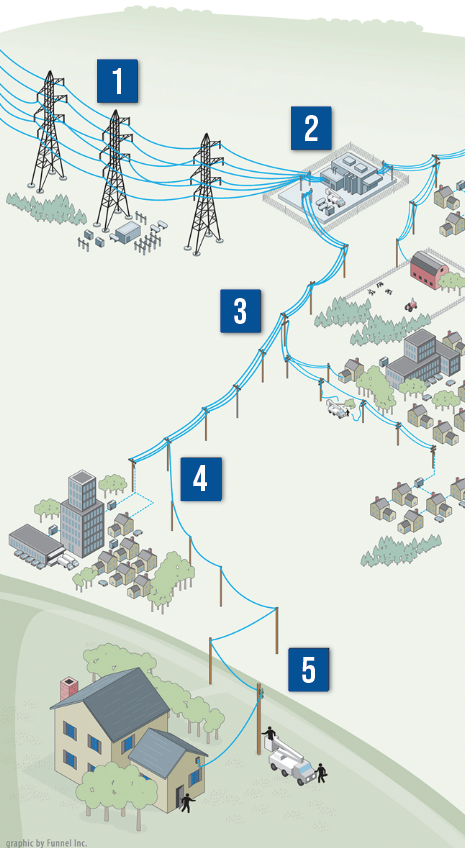
Transmission towers and lines rarely fail, but when they do, they must be repaired before the rest of the system can work.
Each substation serves hundreds or thousands of members. During a major outage, crews check whether the problem is in the transmission lines, the substation, or further down the line.
If the problem is not at the substation, crews check distribution lines, which deliver power to neighborhoods and communities.
If local outages continue, crews inspect tap lines, which deliver power to transformers serving homes, businesses, and schools.
If your home still has no power, the service line from the transformer to your house may need repair. Always report outages to help crews pinpoint the problem.
STOCK YOUR HOME WITH ESSENTIALS
TAKE EXTRA PRECAUTIONS
KNOW HOW TO REPORT OUTAGES